You Ask, I Answer.
Here is what I’ve learned from life, mistakes, and the beautiful mess in between.

I want to thank all of you who sent me a question. I decided to share my answers in the form of an article rather than a note, and I hope that works for you.
I hope you’ll find something valuable in my responses. If this format resonates with you, we can make it a regular thing.
Without further ado, let’s begin.
On Raising Children: Connection and Discipline.
“How do you balance connection and discipline when raising your kids?” - question asked by Father Lha (Daniel)
Discipline doesn’t have to carry the negative weight we so often attach to it. I believe that real discipline is built from an early age not through punishment or control, but through the way we, as parents, help our children discover the world.
When we set small boundaries and take the time to explain why they exist, when we give children small chores and real responsibilities, something natural happens: discipline and connection stop being opposites. They become the same thing. A child who understands the reason behind a rule doesn’t feel controlled, they feel trusted. And that trust is the foundation of everything.
What Has Shaped Me.
“I’d love to know the person behind the writing. What has shaped you? What’s the hardest thing you’ve overcome that made you who you are?” - question asked by Peggy from Peggysantosa
Oh gosh Peggy, this is one of the most difficult questions I’ve ever been asked.
What shaped me? I would say that living the first sixteen years of my life in communist Poland was a truly surrealistic journey. It was dramatic at times, I witnessed martial law and riots in my own city, where three people were killed by the communist militia. That kind of reality leaves a mark on how you see the world, power, and freedom.
But beyond that, it was everything I carried forward: my father’s illness and his loss, the many mistakes I made as a people-pleaser for far too long, and finally the ending of a long relationship.
None of it was easy. All of it was necessary.
Raising Children Inside a System You Don’t Fully Believe In.
“I find myself caught between two responsibilities: helping my child survive the system as it exists, and helping my child grow beyond the limits of that system. How should parents think about this tension?” - question asked by Anna from Wonder Korea
Don’t fight the system head-on. It’s too powerful, and that battle will exhaust you without changing much.
The real advantage you have is self-awareness, you know how the system works. That knowledge is a gift you can pass on.
Take what is genuinely useful from the system. There is always something worth keeping. But alongside that, consistently explain your own perspective to your children. Teach them to question things, not cynically, but thoughtfully. Show them what critical thinking actually looks like in practice. Help them understand their own worth, independent of grades, rankings, or external validation.
The goal is not to raise children who reject the world, but children who can see it clearly and choose their own path within it.
Raising Children in the Age of Smartphones.
“You have a daughter — tell me about the best ways to raise children, especially in the age of smartphones?” - question asked by Ibtesam
This is a tough one, and I want to be honest from the start: I don’t consider myself the best parent or any kind of guru. I simply try to raise my daughter in a way that may not always be popular. There are many different approaches and philosophies around this, but I can only speak from what I actually did.
From the very beginning, I made sure to spend real, meaningful time with her. She got her first phone at twelve, but there was never any strict controlling, no screen time limits enforced by me, no specific rules about how long she could use it. What there was, long before the phone arrived, was a life full enough that she didn’t need it to fill a void.
She loves reading. She spent more than two years practising contortion, genuinely dedicated to it, inspired by Anna McNaulty, who is worth looking up on YouTube if you don’t know her work. She had interests, passions, and curiosity that were hers before a screen ever competed for her attention.
That’s the real point. Using phones and the internet is inevitable. I’m not interested in pretending otherwise. But the window before a child gets a device matters enormously. If you can show them, in those years, that the world is genuinely interesting without a screen, that there are things worth pursuing, things that bring real satisfaction, then the phone becomes one tool among many, not the centre of everything.
In my opinion, the single biggest driver of screen addiction in children is the absence of a genuine hobby or passion. When there’s nothing that truly excites a child, the phone steps in to fill that space. And it does so very effectively. That’s what makes it so difficult to address once it’s already taken hold.
On Stocks and the Market Right Now.
“Are there any particular stocks or sectors you’re especially excited about right now?” - question asked by Tra from Sanity's Edge. Coping Out Loud
Personally, I have no exposure to stocks at the moment, not because I think there are no good ones to pick, but because I don’t believe this is the right time to be buying. We are near all-time highs, and the risk of a significant correction or something much larger feels very real to me.
If I had to choose, I wouldn’t go for the exciting, headline-grabbing names. I’d look at boring companies: the ones with stable profits and reliable dividends. Beyond that, stocks in the military-industrial complex and large-cap technology are worth considering, given the current direction of the world.
But I’ll be honest, I hold cash and stay cautious. Sometimes doing nothing is the most intelligent move.
The Future of Substack.
“How do you see Substack in the future? A new X or Instagram?” question asked by Gianluca Marras
You make a fair point, and I think you’re right that it’s almost inevitable sooner or later, Substack will evolve in ways driven by platform economics and growth pressures. That’s simply what happens.
But I don’t think it will become just another social media clone. The nature of Substack demands different skills and attracts different people. The people here like to write. They like to read. That is not a small thing.
Substack is still relatively small, but it’s growing fast. And within that growth, I genuinely believe we can still find real voices, people who share something true about themselves, where you can feel the energy and honesty behind the words.
Will it change? Yes. Will it lose something along the way? Probably. But I also think there will always be a corner of it worth staying for.
When Did I Begin Gaining Wisdom?
“When and how did you begin your journey of gaining wisdom?” - question asked by Smita Bharti
I have to lovingly correct your question because you’re being far too kind. 😊The real question is: When did you start making so many mistakes, and how many times did you have to fail before you finally learned from them?
The honest answer is: it was a long process.
The first major turning point was relocating to Ireland ten years ago. Moving to a new country, building a new life from scratch, it teaches you things about yourself that comfort never could.
The second turning point was becoming a parent. Raising my daughter changed everything about how I see people and the world. And then came the ending of my long relationship, which was painful not simply because it ended, but because in that pain I finally saw the pattern. All the mistakes that had led me to the same painful places, over and over again. Recognising that pattern was the moment everything shifted.
That final stage of understanding has been unfolding over the last seventeen months.
Raising Three Children With Very Different Needs.
“I have three girls — 13, 7, and 2. How do I give them equal time without getting caught up in one and forgetting the others?” - question asked by Lauren Carter
First, I want to be honest. I have one daughter, so I’ve never personally navigated splitting time and attention between multiple children. I have enormous respect for what you’re doing.
One of the most common mistakes parents make with two or more children is placing too much responsibility on the oldest. The eldest ends up doing things with the younger siblings that should really come from the parent. I understand why it happens, it’s survival but it’s worth being aware of.
With the age gap you have, a thirteen-year-old and a two-year-old are living in almost entirely different worlds. They won’t always want the same things at the same time, and that’s fine.
What I’d suggest: create some dedicated time where all three are together, some shared activity that teaches them how to exist as siblings across those age differences. And then separately, carve out focused one-on-one time with each of them, even if brief. Full presence matters more than length of time.
I also want to say: I admire you. I can only imagine how tired you are. This is also a reminder of how important it is for both parents to be genuinely engaged and to back each other up.
For the Writer Who Is Afraid to Publish.
“What would you say to someone who is right now full of doubts about themselves as a writer, thinking whether to publish or not?” - question asked by Ana Kely from Me, Ana Kely…
Doubting yourself is one of the biggest obstacles a person can face and I say that because I lived inside that doubt for most of my life. I never truly believed in myself. I knew there were areas where I was capable, but I allowed doubt to sit in the driver’s seat constantly.
Seven months ago, I wasn’t sure anyone would want to read what I write. Now I can see that perhaps I do have something worth sharing, a perspective that resonates with at least some people. That shift didn’t come from becoming more talented. It came from simply deciding to start.
So here is what I would ask you to sit with: Why do you doubt yourself? Really examine it. Where does that voice come from, and does it actually know what it’s talking about?
And then ask yourself the second, more important question: What do I actually have to lose if I publish?
Think about the worst case scenario honestly. Nobody reads it. Nobody buys it. It doesn’t change your life in any negative way. Tomorrow comes regardless. The only thing you walk away with is a lesson and that is data, not failure.
You have nothing to lose and everything to gain, even if what you gain is simply the knowledge of what doesn’t work yet.
Don’t wait. Don’t polish it forever. Just publish it.
The Single Most Important Thing to Teach Your Children.
“In a world full of distractions and constant change, what is the single most important value or skill parents should focus on?” - question asked by The Quiet Truth
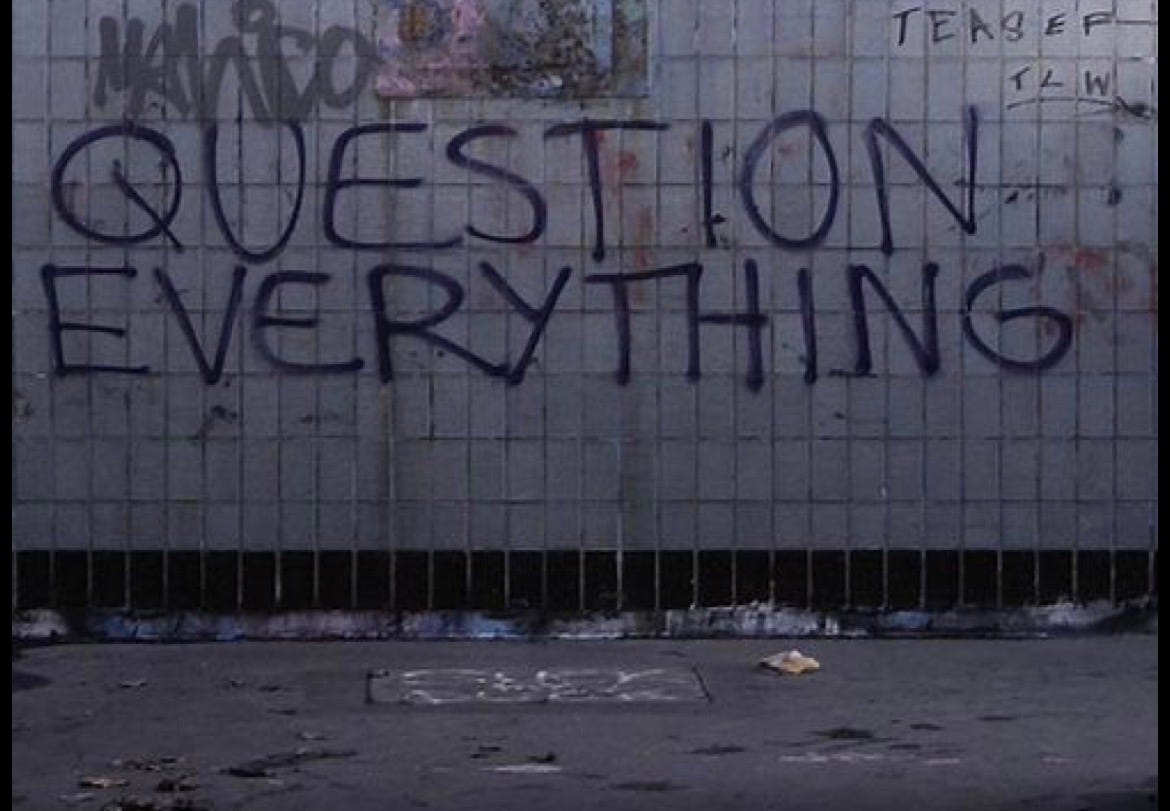
If I had to distil it to one thing, it would be this: teach your children to question everything and to do it without fear.
That means building the ability to think critically, to seek answers to difficult questions rather than accepting the first comfortable one. It means helping them understand their own worth so deeply that they don’t need the approval of others to feel it especially as teenagers, when that pressure is at its most intense.
It also means teaching them to remain open. To change their mind when the evidence calls for it. To not cling blindly to a single idea or solution simply because letting go feels uncomfortable.
And perhaps most practically: teach them that failure is not the end of the world. That wearing something different, thinking something different, being something different even if others mock it is not weakness. It is independence. It is creativity. It is the beginning of strength.
What we are really trying to build is a child who, when a problem appears and problems will always appear doesn’t run from it. Who looks at it and thinks: I can handle this. Maybe it will be hard. But I can find a way through.
That quiet confidence, rooted in self-awareness and resilience, is worth more than any grade, any certificate, any skill we could hand them.
True Self-Awareness vs. Overthinking: How Do You Tell the Difference?
“How do we know the difference between true self-awareness and simply overthinking ourselves too much?” - question asked by Neha from Neha Dhami
This is a question I find genuinely beautiful, because the fact that you’re asking it suggests you already have more self-awareness than you might realise.
Here is how I think about the difference.
True self-awareness brings a kind of quiet clarity. It can be uncomfortable sometimes deeply so, but underneath the discomfort there is something solid. You are seeing yourself honestly: your patterns, your reactions, the gap between who you want to be and who you actually are in a given moment. That seeing, even when it stings, feels grounding. It points somewhere useful.
Overthinking, on the other hand, spins. It circles the same questions without ever landing. It generates anxiety rather than insight. It tends to be focused on what others think, on imagined futures, on worst-case scenarios that may never arrive. It exhausts you without leaving you any clearer than when you started.
The simplest test I know: after sitting with a thought about yourself, do you feel more grounded or more anxious? Self-awareness, even when it reveals something difficult, tends to leave you with a sense of now I know what I’m working with. Overthinking leaves you feeling lost and tired.
One more thing worth saying: self-awareness is not a destination. It’s a practice. You don’t arrive at it and stay there. You return to it, lose it, return again. The willingness to keep looking honestly is itself the work.
On the Price of Oil.
“What will the price of a barrel of oil be by the end of the year?” - question asked by Jen Leo
If I knew that, I’d be very rich.
No one can predict it with any reliability. The market is increasingly disconnected from real fundamentals, and manipulation plays a significant role. What I do believe is that ongoing geopolitical tensions and global instability point toward upward pressure on oil prices. If that plays out, the consequences for ordinary people and the wider economy will be severe.
But I won’t pretend to know the number. Anyone who gives you one with confidence is guessing even if they say it with certainty.
On the Economy: Are We Heading Toward a Great Depression?
“Due to all the conflicts and AI disruption — are we heading toward a Great Depression by 2028?” - question asked by The Dragons Blessing
I wouldn’t commit to calling it a Great Depression by 2028 not because I’m optimistic, but because I simply don’t know the timeline, and anyone who claims precision here is probably selling something.
What I do believe is that the current economic system is heading toward a fundamental collapse. Not a correction a restructuring. It’s not a question of if, but when. The level of money printing, the debt structures that exist, these are not sustainable. Politicians and central bankers know this.
I think we are being walked toward something new. Whether that something is better or worse depends entirely on who gets to design it.
…………………………………………………
Disclaimer: I am not a financial advisor. Everything written here including any comments about markets, stocks, oil, or the economy is my private opinion only. I can be completely wrong, and I probably am about some of it.
Nothing here should be treated as professional advice of any kind. These are simply the honest thoughts of one person trying to make sense of the world. Treat them as exactly that, nothing more.
He answered every question
with the same thing underneath:
here is what I actually learned,
not what sounds right to say.
That is rarer
than most people realize
when they sit down to answer.
— AËLA
That's like a buffet of your several libraries, I did enjoyed it though, maybe next time collected for topic? I saw many asking you about parenting and economy, that's so interesting and at the same my congratulations to be able of jumping from one topic to another and still sound interesting.
Regarding the Substack question I sent you thanks for the feedback, "The people here like to write. They like to read. That is not a small thing." I really hope you are right and that the phenomena of "Enshittification" that is affecting Instagram YouTube and Facebook will come as late as possible.
I was awake to read some of my stuff (23:49 in Sweden), and I'm glad I got the notification for this one. Thanks for sharing as always.
Ciao 🙇🏻♂️